

Every new mom has a moment where she asks herself Is this normal? It is natural to feel abnormal! It is completely okay. The truth is, nothing can fully prepare you for the first few weeks of motherhood. If you feel abnormal, emotional, or like everything is too much, that is not a sign that something is wrong. That is simply what this phase of life looks like.
Struggling doesn’t mean you’re doing something wrong. This is a new experience for you, so you are struggling. Your body and your heart are carrying something very big for the very first time. Many new moms find that building even a basic newborn feeding schedule first week gives them something solid to hold onto when everything else feels uncertain. Things become easier when you realize that. And that is exactly where we should begin.
Table of contents
Why do new moms struggle?
New moms struggle because motherhood does not come slowly. It comes all at once. Your body is still healing. Your baby needs you for everything. Your feelings are strong and hard to control. And you are already trying to breastfeed, all before you have had one moment to feel ready. On top of this, questions like how often should a newborn sleep at night keep running through your mind, making it even harder to focus on one thing at a time.
You are not just learning to feed a baby. The first time you become a mother is a learning experience. You are surrounded by new and unfamiliar things. You are still recovering from childbirth. Sleep disappears almost right away. Your hormones change in ways you did not expect, bringing mood changes and strong emotions that are hard to explain. With all of this happening at once, even the smallest decisions can feel like too much.
| Challenge | What happens | Why it matters |
|---|---|---|
| Hormone change | A hormone called progesterone drops after birth | This starts milk production, but also causes mood changes and strong emotions |
| Body healing | The body recovers from birth at the same time | This takes energy away from feeding |
| No sleep | The baby wakes up many times at night | Lack of sleep makes it hard to focus and stay calm |
| Worry about feeding | Every cry feels like hunger | This stress makes feeding harder |
| Breast engorgement | Milk comes in strongly around day 3 to 5 | The breasts become full, hard, and sore, making it difficult for the baby to latch |
Feeding problems do not come alone. They come when your body is still healing, when you have not slept, and when your emotions are already very high. This is why so many new moms feel overwhelmed.
Quick fact: Most breastfeeding difficulties in the early weeks are not permanent. With the right support and small changes, almost every common problem can be fixed.
Common feeding problems
When breastfeeding feels hard, there is usually a reason. The most common problems new moms face are pain, a poor latch, and low milk supply. These three problems do not always arrive separately. Most of the time, one problem leads to the next. This is especially true for moms dealing with a newborn not sleeping unless held, where exhaustion builds quickly and makes every feeding challenge feel even harder. By the time a new mom realises something is wrong, all three are already happening together.
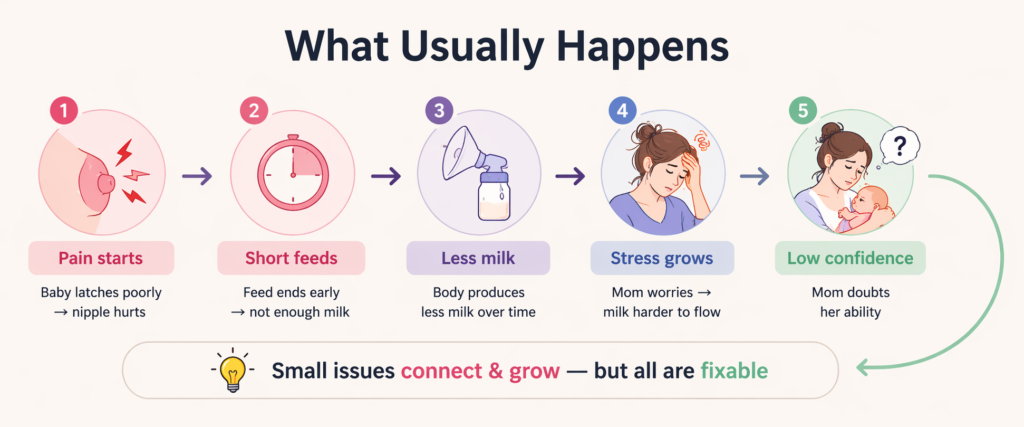
Here is how it happens, step by step:
Step 1: Pain starts
When the baby does not latch onto the breast properly, the nipple carries all the pressure instead of the whole breast. This causes the soreness and pain that many new moms feel during feeding. Most new moms think this pain is just part of breastfeeding and continue without realising that correcting the latch can make the pain stop completely.
Step 2: Feeds become shorter
When feeding is painful, the mom ends the feed early to stop the pain. As the feed ends too soon, the baby does not get enough milk, and the breast does not empty fully. And when the breast is not fully emptied, the body slowly starts to produce less milk.
Step 3: Milk supply goes down
The body produces milk based on how much the baby drinks. When feeds are cut short regularly, the body receives a signal that less milk is needed. Over time, milk supply begins to drop without the mom even noticing.
Step 4: Worry increases
When a mom notices that her milk is reducing, worry and stress follow naturally. Stress affects the body in a real way. It tightens the muscles and slows down the hormones that help milk flow. This makes each feed more difficult than the one before.
Step 5: Confidence drops
When pain, low milk, and worry all arrive together, it becomes very hard for a new mom to keep going. She starts to believe that breastfeeding is not working for her. But what she does not know is that each of these problems has a clear reason behind it, and every single one of them can be fixed.
At the same time, everyone around her wants to help. But every person says something different. Some say feed every two hours, others say wait longer. Some say try the formula, others say never do that. Every person has a different opinion, and each opinion feels irritating. For a mom who is already exhausted and unsure, all of this different advice only adds to the confusion. What she needs most right now is simple and clear guidance.
This is why it is important to take a step back before trying to fix anything. Starting with the baby is the best place to start. Before a feed even begins, the baby is already giving small signals to show that they are hungry. Learning to recognise those early signals is what makes feeding smoother and everything else easier to handle.
Signs your baby is hungry
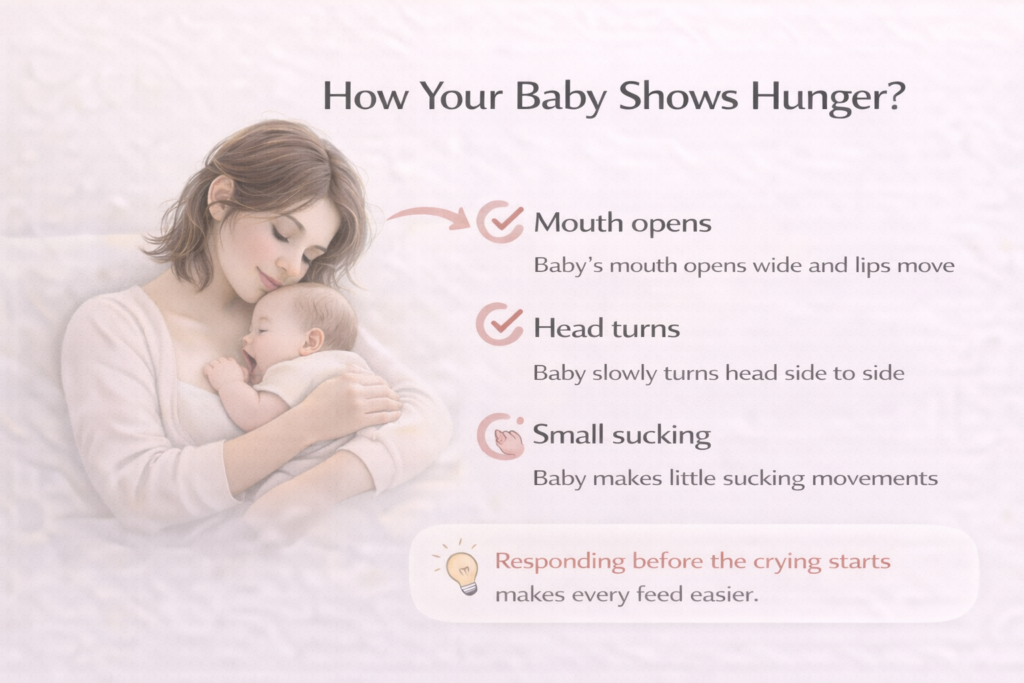
A baby will not cry if he or she is hungry. Crying is actually the last thing they do. Long before that, they give small, gentle signals that they are hungry. Learning to recognize these early signs makes feeding calmer and much easier for both the mom and the baby. Following a rough 2 week old baby sleep schedule also helps here because when you know when your baby last slept and fed, spotting those early hunger cues becomes much easier before they turn into crying.
Many moms only notice hunger when the baby starts to cry. But by that point, the baby is already distressed. A distressed baby is harder to latch because the body becomes stiff and the mouth is not in the right position for feeding. Starting a feed before the baby reaches that point makes everything easier.
- Baby’s mouth opens wide — When a baby is hungry, the mouth opens wide, and the head turns slowly to one side. This is called rooting. A baby who is rooting is calm, relaxed, and ready to latch well. This is the best moment to start a feed.
- Crying comes too late — By the time a baby is crying, hunger has already been building for a while. The first sign of hunger is not crying. It is the last one. Learning to respond to the earlier signs, like rooting, small sucking movements, and little sounds, is one of the most helpful things a new mom can do in these first few weeks.
- Feeds become faster over time — In the first two weeks, something changes that many moms find confusing. A feed that once took 40 minutes may now take only 20. This does not mean the milk is reducing. It means the baby is growing stronger and drinking more efficiently. Both the baby and the feeding are moving in the right direction.
Quick fact: A baby who is rooting is calm and ready to latch well. Responding before the crying starts makes every feed easier.
Why does milk supply drop?
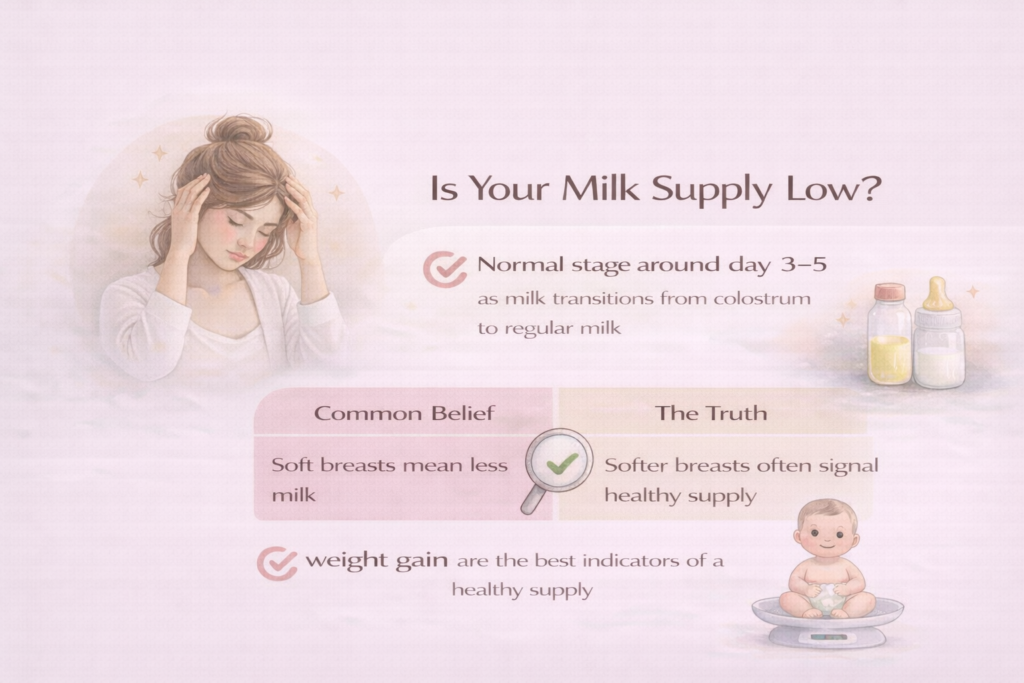
Worrying about milk supply is very common for new moms. But in most cases, the body is not failing. The supply drops because the body is not receiving enough signal to keep producing. A lot of moms also ask whether a newborn waking up every hour is normal, and the answer is yes, especially in the early weeks when the stomach is small, and feeds are frequent. These night wakings are actually helping to build and maintain milk supply.
In the first few days, the body produces a special milk called colostrum. It looks and feels different from regular milk and comes in very small amounts. Many moms worry that it is not enough. But the baby’s stomach at this stage is also very small, so colostrum is exactly the right amount. Around days three to five, regular milk comes in. This feels sudden, but it is a normal and healthy change.
Many common beliefs about milk supply cause unnecessary worry. Here is the actual truth:
| Common belief | Truth |
|---|---|
| Small breasts make less milk | Breast size has nothing to do with how much milk the body produces |
| Soft breasts mean less milk | Softer breasts after a few weeks mean milk supply has settled. This is a good sign |
| The baby feeds too often, so milk is not enough | Feeding often in the first weeks is what builds and maintains milk supply |
| The amount pumped shows the total milk supply | A baby draws milk better than any pump. Low pump output does not mean low supply |
The most reliable way to know if the baby is getting enough milk is to watch three things
- Wet nappies,
- Dirty nappies,
- Weight gain.
If all three are on track, the body is doing its job. These signs are far more accurate than how the breasts look or feel between feeds. It is also worth knowing that many supply problems are actually latch problems that have not been noticed yet. When the baby cannot draw milk properly, the body gets fewer signals to make it. This is why fixing the latch early makes a big difference to everything that follows.
How does the latch affect the baby?
The latch controls how much milk the baby gets and how much pain the mom feels. A good latch means the baby feeds well and the mom feeds comfortably. A poor latch affects both at the same time. It is also one of the most common reasons a baby cries after feeding even when not hungry because a shallow latch leaves the baby gassy or still uncomfortable even after the feed ends.
- Good latch — Baby’s nipple goes deep into his mouth. The tongue moves smoothly and draws milk out easily. The baby drinks well, feels full, and is calm and settled when the feed ends.
- Poor latch — The nipple sits near the front of the mouth. Every suck puts direct pressure on the nipple, which causes pain. The baby works harder but still gets less milk, and often stays unsettled even after the feed.
Here is how to tell whether the latch is working or not:
| Sign | What it means ? |
|---|---|
| Pain stops after the first minute of feeding | The latch is good and improving |
| Pain continues throughout the whole feed | The latch needs to be corrected |
| The nipple looks round and normal after the feed | Milk is coming out well |
| The nipple looks flat or squeezed after the feed | The baby needs to take more of the breast into the mouth |
| The baby is calm and sleepy after the feed | The baby is full |
| The baby is restless after the feed | The baby may not have drunk enough |
When the latch improves, everything else gets better too. Even the pain reduces, and the milk supply becomes stable. The baby drinks more at each feed. And gradually, feeding becomes easier for both the mom and the baby.
What makes breastfeeding easier?
Breastfeeding gets easier with small changes in position, timing, and the right support. You do not need to spend money on special products or programmes. After a feed, always take a moment to wind your baby properly. Many moms are unsure how to burp a baby that won’t burp, and bringing the baby upright, gently supporting the chin, and patting the back in slow, firm strokes can release trapped air that causes fussiness and discomfort long after the feed ends.
- Let the chin lead first — Before the baby latches, the chin should touch the breast first. This helps the baby open the mouth wider. The nipple goes deeper inside. And the latch becomes more comfortable. Many moms who felt pain for several days found that this one small change helped them immediately.
- Do not wait too long between feeds — Do not wait more than three hours between feeds. The breast becomes too full and hard. The baby becomes very hungry and upset. Both of these make latching more difficult. Feeding more regularly keeps everything balanced. The breast stays comfortable. The baby stays calm. And the milk supply stays steady. And every feed that goes a little better gives the mom something real to hold onto. Over time, those small moments build into a true feeling that things are working.
- Right people make a real difference
- Partner: Helps at home so the mom gets time to rest. When the mom rests well, the body produces milk better.
- Doctor or health visitor: Checks in regularly and catches small problems before they grow bigger.
- Lactation consultant: Watches a full feed and gives specific guidance.
- Another mom: Gives honest reassurance that it does get easier. That reassurance matters just as much as any practical advice.
The early weeks are the hardest. But with small changes and the right support around you, things slowly start to feel more manageable than you expect.
When to worry
Most early breastfeeding difficulties are normal. But some signs need medical attention quickly. Symptoms that may require medical attention include:
- Fewer than 6 wet nappies in 24 hours after day 4.
- There has been no return to birth weight by two weeks.
- Nipple pain is very strong, does not ease during the feed, and the nipple looks wounded after every session.
- One breast feels hard and looks red, and you also have a fever or feel sick. This could be mastitis (breast infection) and needs quick medical attention.
- You feel deeply sad, disconnected from your baby, or feel like you cannot manage. These feelings do not go away even after resting.
You know your baby better than anyone. If something does not feel right, trust that feeling and speak to your doctor early. Most problems are easier to handle when they are caught in time.
Every mom finds her way
The first few weeks of breastfeeding are genuinely hard. Not because you are doing something wrong, but because everything is new at once. Your body is healing, your sleep is broken, and you are learning something completely unfamiliar while running on very little rest. Building even a loose newborn feeding schedule first week can bring small but real moments of calm into an otherwise unpredictable time.
But here is what is also true. Most of the problems that feel permanent in these early weeks are not permanent. A painful latch can be corrected. Milk supply can be rebuilt. Confidence comes back, slowly but surely, with every feed that goes a little better than the last.
Every mom who gets through this phase does it the same way. Not perfectly. Just consistently. Day by day, feed by feed, things shift. The baby grows stronger. And so do you. The difficult weeks do not last. But the confidence you build inside them stays with you forever.

Frequently Asked Questions
How do I know if my baby is latching correctly?
A good latch feels comfortable after the first minute. The baby’s mouth covers a large part of the breast, not just the nipple. The chin touches the breast, and the lips are turned outward. After the feed, the nipple looks round, not flat or pinched. The baby is calm and settled when the feed ends.
How often should I feed my newborn?
In the first weeks, feeding every two to three hours is normal. This means eight to twelve feeds in twenty-four hours. Frequent feeding builds milk supply and keeps the baby growing steadily. Do not wait for the baby to cry before starting a feed — watch for early hunger signs like rooting and sucking movements instead.
Why does my baby seem unsettled after every feed?
An unsettled baby after a feed is often a sign of a poor latch. When the latch is shallow, the baby works hard but gets less milk. Try adjusting the position so the chin touches the breast first before the baby opens the mouth. If the problem continues, a lactation consultant can watch a full feed and identify exactly what needs to change.
Is it normal for breastfeeding to hurt?
Mild discomfort in the first few seconds of a feed is common in the early days. But pain that continues through the whole feed or leaves the nipple looking flat or damaged is a sign the latch needs to be corrected. Pain that does not improve needs a latch assessment as soon as possible.
How do I know my baby is getting enough milk?
The most reliable signs are wet nappies, regular dirty nappies, and steady weight gain after the first few days. A baby who is feeding well will have at least six wet nappies in twenty-four hours after day four. Weight gain and nappy output matter far more than how the breasts feel between feeds.
When does breastfeeding get easier?
Most moms find that breastfeeding becomes noticeably easier between weeks three and six. The latch improves, feeds become faster, and the baby begins to settle more predictably after each feed. The early weeks are the hardest part. Every feed that goes a little better is a sign that things are moving in the right direction.