
Learn when a premature baby catches up, how corrected age works, and simple daily newborn care tips to support your baby every step of the way. The nights can feel quieter than you expected when you bring your premature baby home.
You start searching for answers that actually fit your situation, but most advice targets a different baby entirely. Questions slowly build up! Is this normal? Are they growing as they should? Why do milestone charts feel hard to relate to?
Your baby arrived before the world expected them. Once you start measuring them against their timeline, most of what you were worrying about starts to look a lot better. But measuring against their timeline means knowing which timeline actually to use. Most parents don’t realise there are two, and that only one of them gives you an accurate picture of where your baby really is.
Table of Contents
Premature baby has two ages – Only one is right
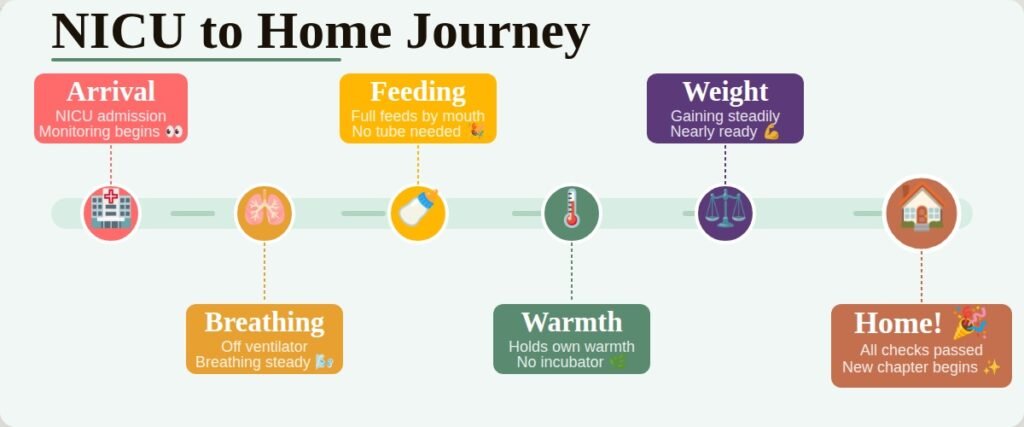
Getting home with your baby is the first real milestone, and from here, each day begins to look a little brighter. This is the moment you truly begin to welcome baby into your everyday life, where each day carries something worth noticing.
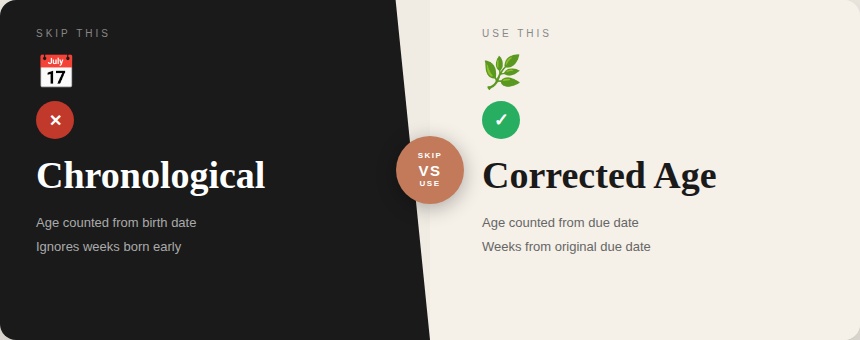
- Chronological age counts from their actual birthday. This is the age most apps, milestone charts, and people around you use to measure your baby’s age.
- Corrected age counts from their original due date. This is the age that reflects where your baby actually is in their development.
Development does not start at birth. It starts at conception. A baby born at 32 weeks did not simply arrive early – they left eight weeks of womb development unfinished. Holding them to the same milestones as a full-term baby of the same birthday is not just medically inaccurate; it is an unfair comparison from the start. Once you make the switch to corrected age, the whole picture begins to look very different.
Quick fact:
Most paediatricians use corrected age until a child is two to three years old. By that point, the developmental gap has typically closed, and the difference no longer applies.
Premature baby’s initial days
Getting home with your baby is the first real milestone, and from here, each day begins to look a little brighter. Each day from this point carries something worth noticing.
- Sleep – Premature babies often sleep more than most parents are prepared for, and this is completely normal. Every period of sleep is strengthening the brain, forming connections and building the foundation for development ahead.
- Feeding – Sucking, swallowing, and breathing at the same time is genuinely hard work for a tiny baby. A consistent baby feeding schedule helps you both settle into a rhythm that feels manageable.
- Progress – Progress may feel invisible for weeks, and sometimes it may not be visible. Premature babies grow in ways that rarely follow a predictable path.
- Sensitivity – Premature babies are still adjusting to the outside world. At this point, loud sounds and bright lights can be overwhelming, and being startled is perfectly normal.
None of this is cause for worry. Every preemie family goes through this, and each small day is quietly moving things forward.
Types of premature birth
Every premature birth falls into a different category, each shaped by how early a baby arrives and the path that unfolds from there.
- Late preterm (34 to 36 weeks) — Babies born at this stage often look full-term, but feeding takes real effort, and the care of a premature babyneeded in the first few days is often higher than what we expect.
- Moderate preterm (32 to 33 weeks) — Babies at this stage are still working on the basics like breathing steadily, feeding well, and holding their warmth. The care around them is shaped entirely by those needs.
- Very preterm (28 to 31 weeks) — Babies born at this stage are still in the earlier phases of development, and a longer NICU stay is a natural part of that. Even after coming home, regular support is an important part of the journey.
- Extremely preterm (under 28 weeks) — Babies born this early need the most time and care in the NICU. After coming home, specialist support in the early years is a necessary and expected part of that journey
Being born early is not a setback. It is simply a different starting point, and every preemie finds their way from there.
Premature baby’s catch up
Development looks different for every baby. The majority of premature babies reach the same milestones as babies born full term by the time they turn 2, and quite a few get there even earlier. This is not just something people say to make you feel better. The research backs it up. Most premature babies catch up in a similar pattern, moving through these stages one by one:
- Social and emotional development comes first — babies begin to smile, respond, and connect often sooner than parents expect
- Physical milestones come next — things like holding their head up, rolling, and sitting follow as the body grows stronger
- Speech and language – take the most time, especially for babies who were born very early
By corrected age, the timeline generally looks like:
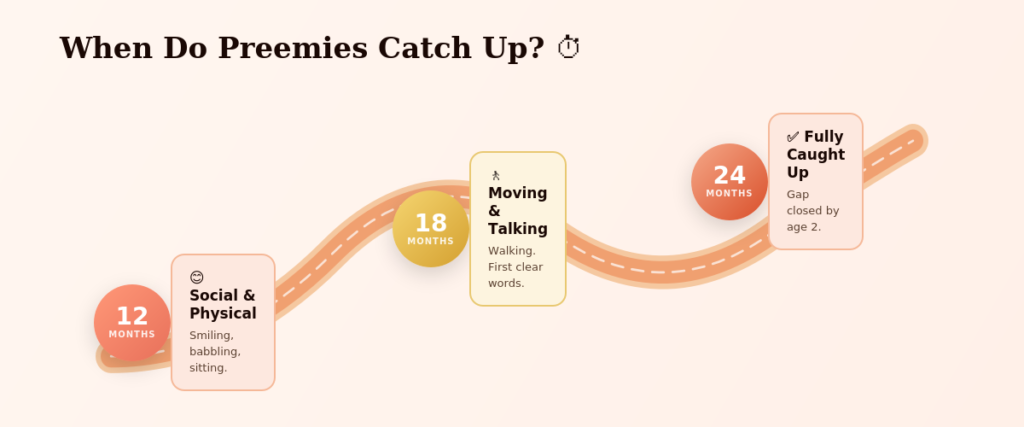
Progress looks different depending on how early a baby arrived, and that is completely expected. A baby born at 35 weeks will naturally close the gap faster than one born at 28 weeks. The direction of progress is what matters, not the speed.
Premature baby milestones
Every preemie develops differently. Milestones show up quietly, and often when you least expect them. Every stage listed here is a guide, not a deadline. Your baby is already working on all of it, one small moment at a time. Each stage below gives you a sense of what is ahead.
Premature baby:
1 to 3 Months – Corrected age
Around this time, you will start to notice things you have been waiting for.
- Your baby starts to open up from their curled position, little by little
- Lifts their head for a second when lying on their tummy
- Starts responding to your voice with small, quiet sounds
These are small moments, but each one is a sign that your baby is moving forward. A few minutes of floor time each day is enough at this stage. Keeping a soft newborn soothing toy nearby is a simple way to comfort them when they need it.
4 to 6 months – Corrected age
The changes are becoming visible, and growth is happening day by day. You will start to notice:
- Rolls from tummy to back for the first time, often surprising themselves when it happens,
- Reaches out toward things they want, showing the first signs of real control
- Starts babbling with sounds like “ba ba” and “da da,” trying them out again and again
- Begins to recognise familiar faces and reacts differently to new ones
These are real steps forward, even when they happen quietly. Talking to your baby through the day is enough to encourage those early sounds. Placing a toy just within reach gives them a gentle reason to stretch and try.
7 to 9 Months – Corrected age
This stage brings some lovely changes. You will start to notice:
- Your baby sits with a little help, and slowly gets steadier each day
- Searches for a toy that has been hidden out of sight rather than forgetting it
- Moves away from unfamiliar faces naturally without hesitation.
Each of these moments is worth celebrating, no matter how small they seem. A few minutes of sitting practice each day is enough for now. A simple hiding game with a toy is all they need to keep their curiosity going.
9 to 12 Months – Corrected age
This is a stage full of big changes, and you will see them in everyday moments. Look out for:
- Dropping something into a bowl and taking it back out
- Copying a simple action they saw just before
- Pointing at things to get your attention
- Picking things up and trying to understand how they work
Every one of these shows that your baby is learning and thinking. A bowl and a few small objects are enough to keep them busy. Follow their pointing and name what they see. This is one of the best things you can do right now.
18 to 24 Months – Corrected age
This stage brings many changes, and you will see them in everyday moments. You will start to notice:
- Putting two words together, like “more milk,” “daddy go,” and “big dog”
- Walking with better balance and steadier steps every week
- Knowing around 50 words now, which is a good sign of healthy growth
Every one of these shows that language and movement are coming together at the same time. Talking through simple daily routine like meals, baths, and walks gives the words they need most. That tiny baby you first brought home is now finding their voice and their feet at the same time.
Daily care
You do not need any expensive programmes to support your baby’s development. Everything your baby needs are those you already have.
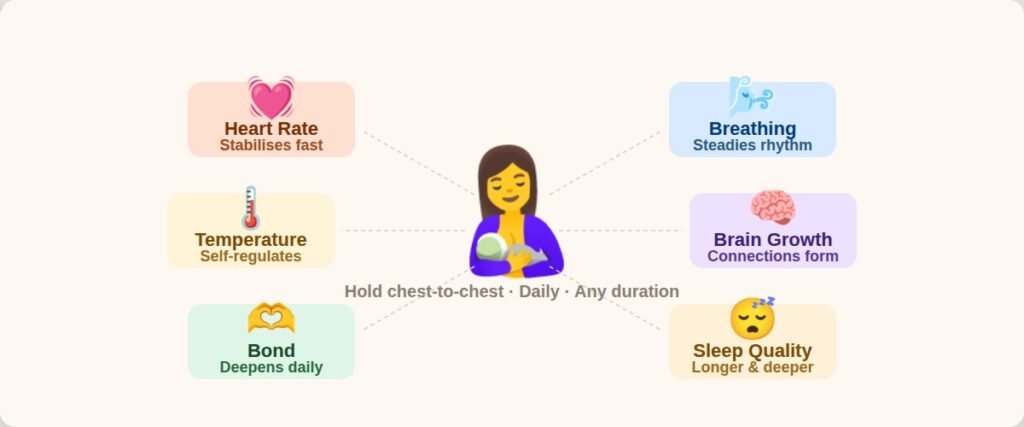
- Kangaroo Care — When you hold your baby skin to skin, their body responds. You can sense it when their heart rate settles, breathing steadies, and temperature balances. This is not just closeness; this is the care they all need. A partner can be part of this too, and it matters deeply for your baby.
- Talk Often —There are no special words needed for this. Just talk. Talking while changing a nappy, giving a bath, or during feeding is enough. Your baby is listening to every word, even when they cannot talk back. Without realising it, every conversation you have with them is quietly shaping their wording.
- Little Tummy Time — You do not need one long session for it to count. Short sessions throughout the day are all your baby needs. Place a soft toy just in front of them and watch them stretch toward it. Every little effort they make is quietly building the strength they will need for holding their head up, rolling, and sitting.
- Play Together — You do not need to buy anything special for this. A soft cloth, a wooden spoon, and a sound from the kitchen are enough. Your baby finds wonder in the simplest things you offer. And in that wonder, they are learning how things feel and sound around them.
- Listen to Your Baby — Your baby has their own way of telling you what they need. When they turn away or go quiet, pause and watch. They are reaching out in the only way they know. Responding to those small moments is how they begin to feel safe with you. That is where your bond begins to grow.
Premature baby warning signs
Most premature babies develop well and reach their milestones beautifully. Always use the corrected age when checking milestones. Early help always makes a difference when it is needed. Speak to your paediatrician if you notice any of these
- Not smiling socially by 3 months
- Not tracking faces or moving objects by 2 months
- Not babbling by 6 months
- Not saying their first words by 14 months
- Fewer than 50 words by 24 months
- Not putting two words together by 24 months
- Arms and legs that feel unusually stiff or floppy with no sign of gradual change
You know your baby better than anyone else does. If something does not feel right, do not wait.
Each uncertain night passed, and each difficult day gave way to the next. Through all of it, you kept showing up for your baby. Premature baby care does not ask you to do everything perfectly. It asks you to show up every day, learn as you go, and trust yourself a little more each time.

Frequently asked questions
How to calculate your baby’s corrected age?
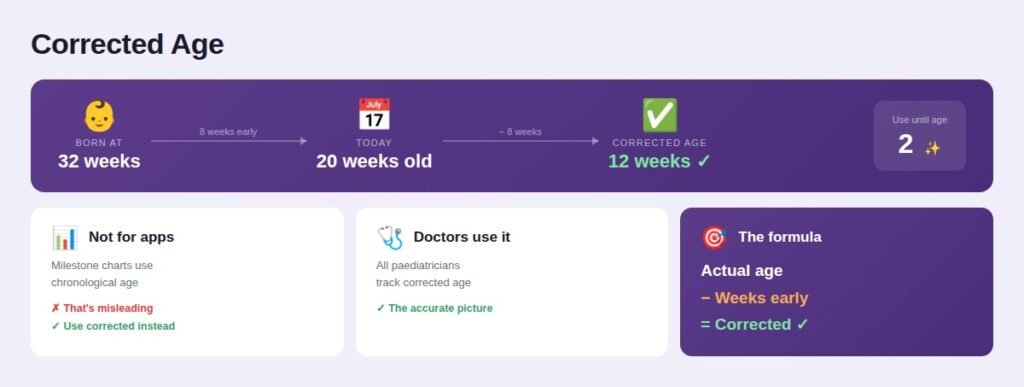
Start with your baby’s actual age in weeks since birth. Then subtract the number of weeks they came early. Take a baby who arrived at 32 weeks and is now 20 weeks old. That baby came 8 weeks early, so their corrected age is 12 weeks. Use the corrected age for all milestone tracking until your baby is two years old.
Do premature babies always catch up developmentally?
Most premature babies catch up to full-term peers by age two. Babies born between 34 and 36 weeks often close the gap earlier. Babies born before 28 weeks may need more time and benefit from specialist support. Catching up is the norm, not the exception.
Milestones at 12 months corrected age
By 12 months corrected age, most preemies smile socially, babble using consonant sounds, sit independently, and respond to their name. Some babies begin pulling themselves up to stand. Always check these milestones against corrected age, not chronological age.
When do premature babies start talking?
Most premature babies say their first clear words between 10 and 14 months corrected age. Two-word combinations like “more milk” or “daddy go” typically appear between 18 and 24 months corrected. Language is the last developmental area to fully catch up, especially in babies born before 30 weeks.
Is tummy time safe for preemies?
Yes, tummy time is safe and important for premature babies. Start with short two-to-three-minute sessions. Repeat several times throughout the day, always on a firm flat surface while you watch. Tummy time builds the neck, shoulder, and core strength your baby needs for later milestones like sitting and crawling.
Corrected age vs chronological age
Chronological age counts from your baby’s actual birth date. Corrected age counts from their original due date at 40 weeks of pregnancy. Always use the corrected age for milestone tracking. Most paediatricians continue using corrected age until a child is two to three years old.