

Are you wondering why you are awake at 2 AM and asking Google about your frustration? Everyone goes through it during the fourth trimester. It is not something that you need to worry about, and it also does not mean you are overacting. Every parent does the same when they are blessed with a new baby. And you are entering into the fourth trimester with a toddler without a proper guide on how to act and when to act.
Does this period last for the next 12 weeks? Yes, you are entering into a tender struggle. How are you going to cope with this beautiful period, which makes a wonderful memory? Take a deep breath, we are here to help you with the seamless fix. And so you will get to know what is normal and what needs attention.
How many trimesters are there in pregnancy?
Most people know pregnancy has three trimesters. But the fourth trimester is the 12 weeks after your baby is born, and it is just as challenging as the ones before it.
💡 Quick Fact
The term “fourth trimester” was coined by paediatrician Dr Harvey Karp to acknowledge that human babies are born earlier than most mammals, with brains still developing rapidly after birth.
It’s hard to understand newborn feelings unless we get into their world. Your baby spent nine months inside a warm, dark, and snug environment. The outside world, with its lights, sounds, and open space, is overwhelming for them. That is why newborns crave closeness, constant feeding, and soothing movement.
They are not manipulating you but are simply adjusting to life outside the womb. Before birth, your womb is their only world. They are just a tiny human struggling to adapt in their new world. Crying is their only way of communicating that they’re struggling. And here is the most beautiful truth of this whole phase. What might it be? You are their only hope and solution for their every problem. As they feel your heartbeat, they sense the world is safe.
Baby blues or Postnatal depression
- Mothers’ health is as important as babies’ feelings. Don’t forget to check on yourself while you are caring for your baby. It is common for new mothers to feel completely drained in the first couple of weeks, a condition known as the baby blues, which passes on its own.
- Postnatal depression differs from baby blues. It doesn’t go away on its own and may persist for weeks or months. If you feel disconnected from your baby or have constant nightmares, it’s important to consult your doctor. Getting the right support is a powerful step toward healing, for both you and your little one.
Week-by-week breakdown of the first 12 weeks
The fourth trimester, the first 12 weeks after birth, is a time of rapid change for your baby’s development and your own recovery. Postpartum recovery brings new challenges as your baby adjusts to life outside the womb and you work on your physical and emotional health. Every week brings something new. Below is a detailed week-by-week breakdown of the first 12 weeks that helps to get through each stage with peace of mind.
Weeks 1 and 2: Day one begins
Do you know what the first two weeks actually feel like? The first two weeks are raw. Your baby is adjusting to feeding, breathing and digesting. You are recovering from birth while simultaneously learning the needs of a completely dependent human. This is normal. This is one of the hardest things a person can do, so don’t give up.
During weeks 1 and 2, expect your newborn to sleep 16 to 18 hours a day but rarely in long stretches. They wake every 1.5 to 3 hours to feed, and this is by design. It is perfectly normal to feed your baby 8 to 12 times a day. Watch for their hunger signs and feed them. Don’t force yourself to do anything.
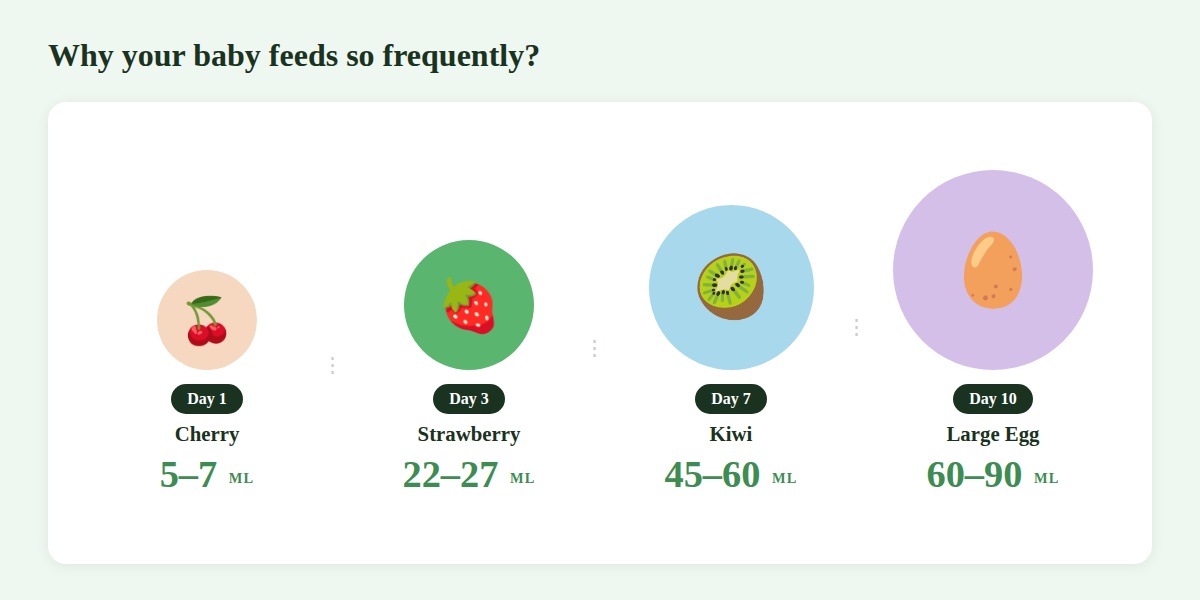
🍒 Did you know?
The newborn’s stomach is the size of a cherry on day 1 and grows to roughly the size of an egg by day 10. This is why frequent feeding is not optional; it is physiological.
You may also notice your baby loses a small amount of weight in the first few days. This is completely expected. It takes most babies between 10 and 14 days for them to regain their birth weight. Your paediatrician will track this at checkups and flag anything that needs attention.
3 Changes to expect
Your baby is going to surprise you in the first two weeks. Your baby cannot tell you what they are feeling, so their body does the talking. A few things may catch you off guard and send you straight to Google at 2 AM. Here is what to actually watch for and what it means.
- Newborn Jaundice – Around day 2, you may notice your baby’s skin turning slightly yellow. This affects more than 60% of full-term newborns and usually fades on its own within one to two weeks. Their tiny liver is still learning to process on its own, and that takes a little time. However, if the yellowing deepens or spreads, or if your baby is sleepy or doesn’t feed well, call your doctor without delay.
- Umbilical Stump – That small dried stump left from the umbilical cord looks a bit odd, and that is completely okay. It will fall off on its own within 1 to 3 weeks. Keep it dry, fold the diaper below it, and leave it alone. But if you notice redness spreading around the base, swelling, or an unpleasant smell – those are signs of infection that need medical attention right away.
- Moro Reflex – You will be sitting quietly, and then a sudden sound or movement makes your baby throw both arms out and pull them back in. It might look alarming, but it is actually a good sign that their nervous system is growing well. If the jerking movements occur repeatedly without a trigger, you should speak with your paediatrician.
Your body after birth
After birth, nobody really prepares you for what happens to your body. Even though it is the biggest concern to look after, your body is healing from the inside out, and the first few days will come with heavy bleeding. This is completely normal and gradually settles over 2 to 4 weeks. Around days 3 to 5, breast milk will begin to flow, and your chest will feel heavy. As you and your baby settle into a feeding rhythm together, things will gradually become smoother over time. Hopefully, things will improve in time. Your body is working hard to heal itself, but it needs your help, too.
- Make sure you sleep whenever your baby sleeps, even if it’s for a short while.
- Eat a proper meal at least twice a day because skipping meals will only slow your recovery down.
- Drink water every time you feed your baby; your body needs it more than you think right now.
These are not small things. This is literally how your body heals.
Call your doctor
Fever above 100.4°F in a newborn always requires a doctor’s attention, not a Google search. Call immediately, don’t wait for it to settle. After day four, count your baby’s wet diapers. An average of 6 or more in a day indicates that the feeding is going well. Fewer than that means you should call your doctor. If your baby is unusually hard to wake up for feeds, it is worth a same-day call to your doctor. Fourth-trimester care isn’t just your baby’s – it’s yours, too. Healing is not just physical. If the sadness is still there after two weeks, that call is long overdue.
Weeks 3 and 4: Healing gets visible
Do you remember that burst of energy you had in the first few days? By week 3, it starts to wear off. Visitors come less often, and the nights feel longer. The first two weeks had adrenaline keeping you going. Week 3 is when that wears off, and the tiredness truly hits. It’s simply the middle phase, and babies cry a lot during this phase. Crying peaks somewhere between weeks 3 and 6. Researchers actually gave this a name. This phase is called the PURPLE crying phase, and here is what it means.

Every parent who has been through it will tell you that it is normal. This is a recognised part of normal baby development, not a reflection of your parenting, and it will pass.
Say yes – every single time
Many parents wait until they are completely exhausted before accepting help, but it doesn’t have to be that way. Say yes when someone offers to bring food, hold the baby for a while, or help with things around the house. Others can find out everything you need to know. Accepting help isn’t a sign of struggle – it simply means you’re taking care of yourself and paying attention to what you need.
When to call your doctor in the fourth trimester?
If your baby cries for more than 3 hours and nothing seems to calm them, it is best to call your doctor the same day. If you have fewer wet diapers than usual or your baby is pushing feeds away, do not wait. You know your baby, so if something feels different, trust that instinct.
Weeks 5 and 6: First smile arrives
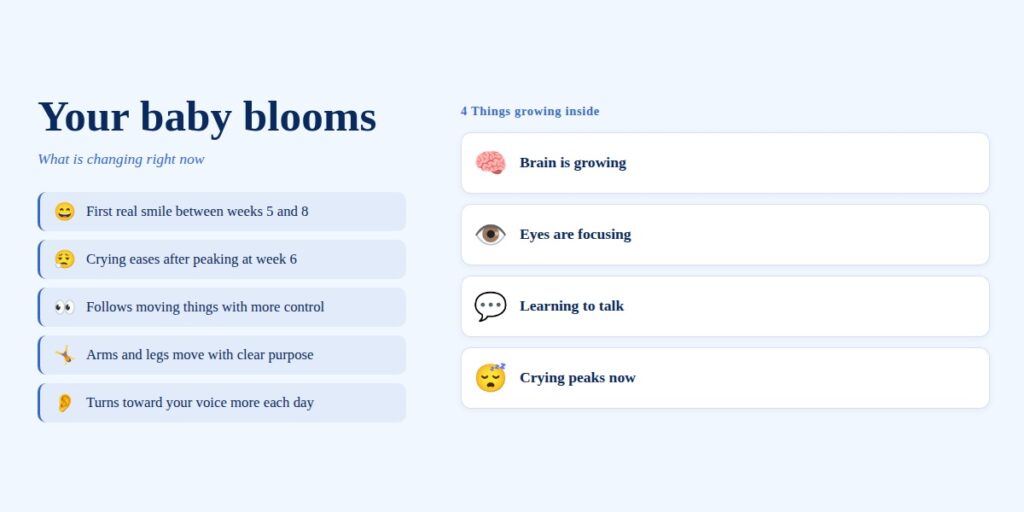
Many parents look back on this week as a turning point. After several weeks of feeding routines and interrupted sleep, something shifts completely. Your baby looks at you and shares their first tiny smile. That tiny smile lands straight in your heart, and without saying a single word, your baby tells you, you are doing an amazing job. A real smile meant just for you appears between weeks 5 and 8. Crying often begins to settle after week 6. Your baby is noticing the world around them. Their eyes follow your movements, their little arms and legs kick with purpose, and the sound of your voice makes them respond in a way that melts your heart every single time.
Feeling like yourself
At your 6th week checkup, you will receive a physical evaluation as well as a mental evaluation of your health. It is important to mention every concern to your doctor. By week 5 or 6, some parents begin to regain their sense of normal routine, while others feel worried about returning to work. Whatever you are feeling during this time is completely understandable, and you do not have to carry it alone.
Call your doctor
Suppose your baby shows no real smile by week 8; it may be helpful to check in with your doctor. Don’t hesitate to seek help when you think of harming yourself or your baby.
Weeks 7 to 9: Settling into motherhood
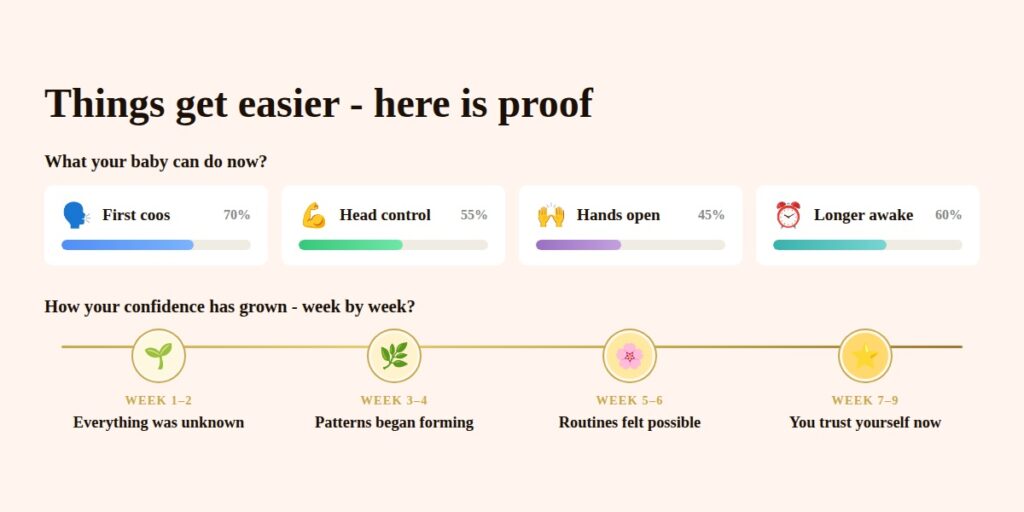
Something begins to shift between weeks 7 and 9. It doesn’t happen all at once, but you’ll start to notice it. Your baby starts making small, happy sounds between feeds. They react to your voice with their whole body. During tummy time, they begin lifting and holding their head for longer stretches. Some babies start sleeping 4 to 5 hours at night during this stage, while others still wake every 2 to 3 hours. Both patterns are completely normal. Every baby follows their own timeline, and that timeline is exactly right for them.
Confidence grows daily
Remember how week 2 felt, when everything was new, and nothing felt certain? Now look at where you are. You can read your baby’s hunger cues, catch their tired signals before the crying starts, and know what helps them settle. That didn’t happen overnight. Every hard day taught you something. And without realising it, you became exactly the parent your baby needed.
Call your doctor
Suppose your baby is making no sounds or noises by this period; that is worth a call. The same applies if they don’t react to loud noises or don’t follow moving objects with their eyes. You know your baby better than anyone, so if something feels unusual, trust your instinct.
Weeks 10 to 12: Bond gets stronger
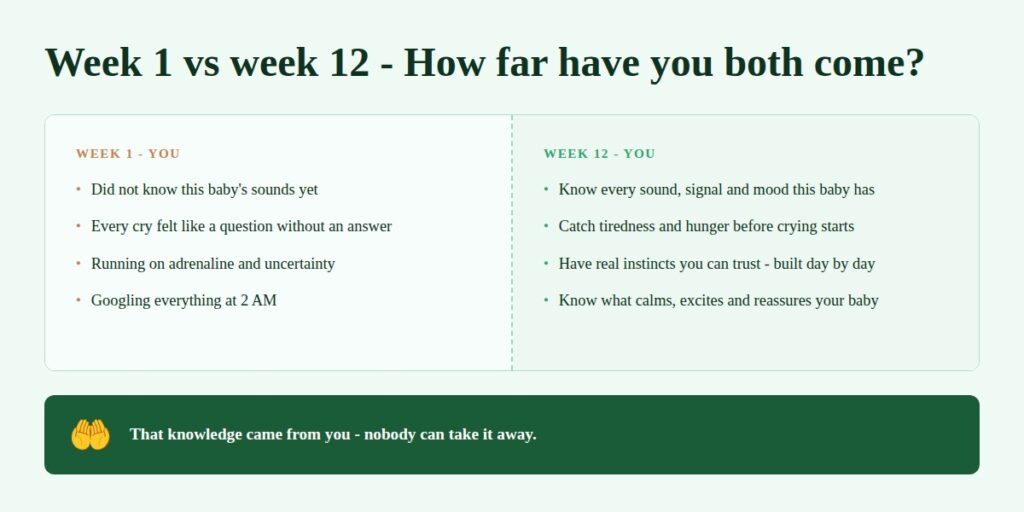
By weeks 10 to 12, babies often show remarkable changes. Their smiles are bigger and brighter now. They know what they like – a favourite toy, a voice that soothes them and a face that makes their whole face glow. During tummy time, they lift and hold their head with stronger control. They make different sounds for different moods throughout the day. Around week 12, their sleep starts to follow a more predictable pattern, and you will feel gifted with that shift. Around this time, your baby may also go through a growing stage and want to feed more than usual for a few days. This is perfectly normal and usually settles back down on its own.
Call your doctor
If your baby is showing no smiling or response to people around them at twelve weeks, or if your own mental health needs attention at any point during these twelve weeks, please call your doctor because it is never too late to ask for support.
What actually helps in the fourth trimester?
You cannot pour from an empty cup. The fourth trimester asks everything of you, often at the exact moment when you are most physically and emotionally depleted. No one hands you a list of what truly helps, but after 12 weeks, many parents realise the same simple habits made the hardest days easier and how to survive the fourth trimester.
- Ask before you run out – Most parents wait until they have nothing left before letting anyone in. Do not do that. Ask earlier. Let people bring food, hold the baby, and handle the house. Let them show up for you the way you are showing up for your baby.
- Skin to skin – Hold your baby close as much as you can in the early weeks. It steadies their heart rate, their temperature, and their stress levels all at once. You will feel the difference before you can even put words to it.
- Talk through everything – Every nappy change, every bath, every feed is a language lesson in disguise. Your voice is building their foundation from week one, and they do not need to respond for it to count.
- Step outside daily – Ten minutes of fresh air does something for both of you that staying indoors cannot do. Make it part of your day, however small it feels.
- Keep a simple log – Track feeds, sleep times, and wet diapers. It takes the guesswork out of your days and gives your doctor something useful at every visit.
- Grab sleep smartly – Sleep does not have to be all night to count. Two solid three-hour blocks of uninterrupted sleep do more for you than a whole night of broken rest if you have a partner, take turns. If not, could you ask whoever is around to cover that window for you? That sleep matters, so protect it.
Do not let yourself disappear into the bubble of home. Reach out to at least one person outside the family every few days. It does not have to be a big plan, a text or a short call is enough. Isolation has a way of making hard things feel impossible. But even a small moment of talking to someone who gets it reminds you that motherhood is part of you, not all of you.
Growth never stops
12 weeks ago, your newborn could not hold their head up. Day and night were meaningless to them. They needed you for absolutely everything. And take a look at where you both are now. Do you remember sitting in the dark in week one, wondering if any of it was normal? Every week in this journey was a phase, and every single one of them passed.
- The nights that went on forever.
- The feeds that never seemed to stop.
- The moments when you questioned everything you were doing.
They all had an end, even when you could not see it. That’s the most important thing to hold onto during this beautiful, tender season. It always gets better. Preparing for the fourth trimester isn’t about being a perfect parent. It’s 12 weeks of small moments where you and your baby learn from each other from the very beginning and grow together. Your journey through these 12 weeks will look different from everyone else, and that is exactly how it should be. Asking for help is never a step backwards. Baby doesn’t need a perfect parent. It is exactly how you are that they need.

FAQ
1. How long does the fourth trimester last?
The fourth trimester begins the day your baby arrives and carries you through the first 12 weeks. It is its own season, tender and transformative, and every single week of it counts.
2. What are the hardest weeks?
For most families, weeks three through six hit the hardest. The adrenaline from birth fades, crying peaks, and the nights feel longer than ever. But this is a recognised phase, it has a name, and it has an end.
3. When do newborns sleep longer at night?
Some babies begin stretching to four or five hours between weeks seven and nine. Others take until months four or five to find that rhythm. Both timelines are completely normal, and your baby’s timeline is exactly right for them.
4. What is the PURPLE crying phase?
It is a recognised part of normal baby development, not a reflection of your parenting. PURPLE stands for Peak crying, Unexpected timing, Resists soothing, Pain-like face, Long duration, and Evening clustering. It typically peaks around weeks three to six and gradually settles on its own by weeks eight to twelve.
5. Is a feeling of disconnectedness normal?
Yes, and you are not alone in feeling it. The bond between you and your baby builds through every feed, every hold, and every quiet moment together. If that feeling lingers beyond four to six weeks, please speak to your doctor. Asking for support is never a step backwards.