The moment your newborn baby arrives, something extraordinary happens — two people who have never truly “met” begin one of the most important relationships of their lives. Bonding with your newborn isn’t just a warm, fuzzy feeling. It is the foundation of your child’s emotional health, confidence, and ability to love others for the rest of their life. But here’s what many new parents aren’t told: bonding doesn’t always happen in a single magical moment. For some parents, it builds gradually, day by day. And that’s completely normal.
We are here to walk you through exactly what bonding is, why it matters, and the simple, powerful things you can do — starting from Day 1 — to build a deep and lasting connection with your newborn.
What is “bonding”? Why does it matter?
Bonding is the deep emotional attachment that develops between a parent and a child. This attachment acts as a safe base from which your baby will eventually explore the world. Research in child development consistently shows that babies who are securely bonded to their caregivers:
- Develop better emotional regulation (they handle stress more effectively)
- Show stronger cognitive development and language skills
- Grow into children with higher self-esteem
- Build healthier relationships as adults
- Are more resilient in the face of life’s challenges
In short, the time and love you invest in your newborn’s earliest weeks pay dividends for a lifetime.
What’s happening in your baby’s brain?
Your newborn’s brain is growing at an astonishing rate — producing 1 million new neural connections every single second. Every time you respond to their cry, make eye contact, speak softly, or hold them close, you are literally shaping the architecture of their brain.
Two key hormones play a starring role in bonding:
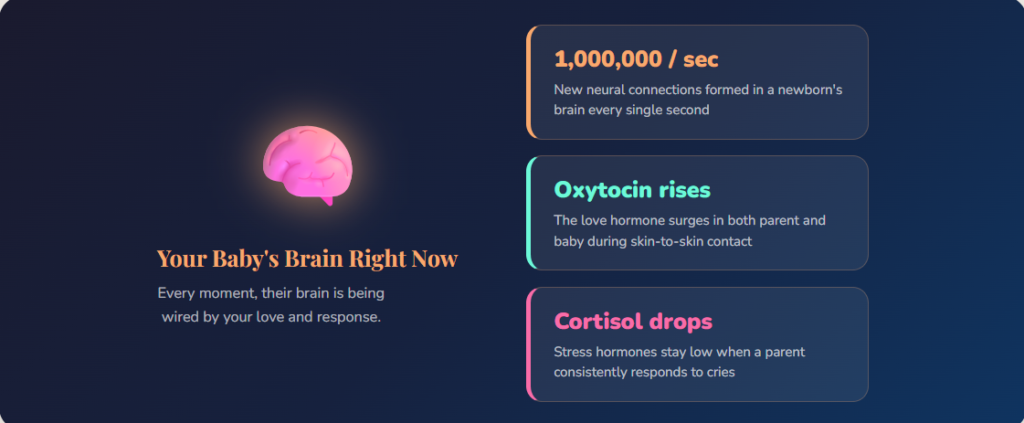
- Oxytocin (“the love hormone”) — Released in both parent and baby during skin-to-skin contact, breastfeeding, and eye contact. It creates feelings of warmth, trust, and attachment.
- Cortisol — When babies feel unsafe or ignored, cortisol (the stress hormone) rises. Consistent, loving responses keep cortisol levels low and help babies feel secure.
The takeaway? Your presence, warmth, and responsiveness are not “spoiling” your baby. They are building their brain.
10 Powerful Ways to Bond with Your Newborn from Day One
1. 🤱 Skin-to-Skin Contact
One of the most powerful bonding tools available to you. Place your bare baby on your bare chest as soon as possible after birth. Studies show skin-to-skin contact:
- Regulates the baby’s heart rate and temperature
- Reduces crying
- Boosts milk production in breastfeeding mothers
- Releases oxytocin in both parent and baby
Dad tip: Skin-to-skin isn’t just for moms. Fathers who practice it report feeling more bonded and confident as parents.
2. 👁️ Make Eye Contact
Your newborn can see clearly at about 8–12 inches — exactly the distance between your face and theirs during feeding. Look into their eyes. Smile. Let them study your face. This simple act signals safety and connection at a neurological level.
3. 🗣️ Talk, Sing, and Narrate
Your voice is the most familiar sound in your baby’s world — they’ve been hearing it in the womb for months. Talk to them constantly. Narrate your day. Sing lullabies. Read aloud. It doesn’t matter what you say — what matters is the tone, rhythm, and warmth of your voice. This also lays the groundwork for language development.
4. 🍼 Respond Consistently to Their Cries
Crying is your newborn’s only language. When you respond promptly and calmly, you are teaching them the most important lesson of their early life: “The world is safe. My needs will be met. I can trust the people around me.”
You cannot spoil a newborn. Responding to their cries is not weakness — it is the very definition of secure parenting.
5. 🛁 Make Routines Tender
Bath time, nappy changes, and feeding are not just tasks. They are opportunities for connection. Maintain eye contact. Use a gentle, calm voice. Narrate what you’re doing. These repeated rituals become deeply comforting anchors for your baby.
6. 🎶 Use Infant-Directed Speech (“Baby Talk”)
Research shows that babies respond better to the higher-pitched, slower, melodic speech that parents naturally use with newborns. Don’t be embarrassed by it — it’s neurologically effective. It captures your baby’s attention and helps them process language.
7. 💆 Infant Massage
Gentle massage using baby-safe oil is a beautiful bonding ritual. Studies show it reduces colic, improves sleep, and promotes healthy weight gain in newborns — while releasing bonding hormones in both of you. A few minutes after bath time is a perfect moment.
8. 🧸 Mirror Their Expressions
Stick out your tongue. Raise your eyebrows. Smile wide. When your baby does the same back — and they will — this is called social mirroring, and it is one of the earliest forms of communication and emotional connection.
9. 🌙 Night Feeds as Bonding Moments
Those 3 am feeds can feel exhausting, but try to reframe them. In the quiet of the night, with just the two of you, there is a special kind of closeness available. Breathe. Make soft eye contact. You are the whole world to this tiny person.
10. 🤝 Share the Load — Both Parents Bond
If you have a partner, share caregiving from the start. Fathers and co-parents who are actively involved from day one form equally strong bonds with their baby, and studies show children benefit enormously from secure attachment to multiple caregivers.
What If I Don’t Feel Bonded Immediately?
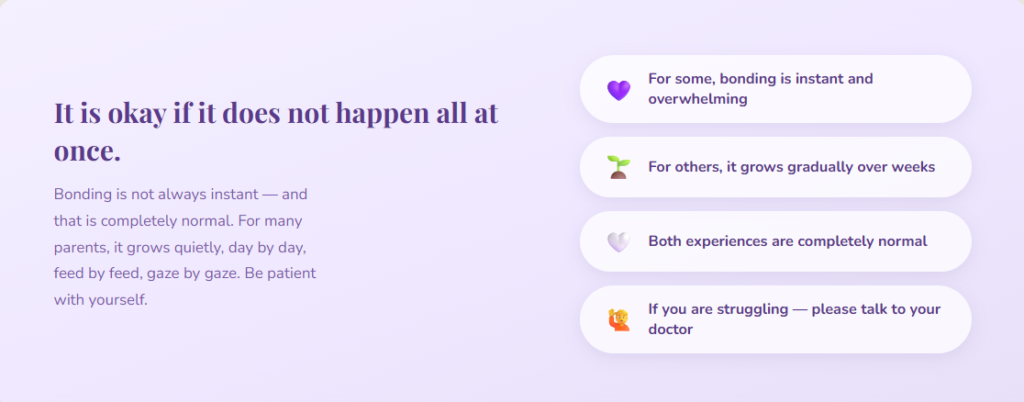
This is more common than most parents admit. The “instant love” narrative puts enormous pressure on new parents. The truth is:
- For some, bonding is immediate and overwhelming.
- For others, it grows gradually — over days, weeks, or even months.
Both are normal.
However, if you feel persistently disconnected, emotionally numb, or are experiencing sadness, anxiety, or dark thoughts, please speak to your doctor or midwife. This may be a sign of postnatal depression, which is common and very treatable. You deserve support.
Note on Discipline and Bonding
It might seem too early to think about discipline when you’re holding a newborn. But here’s a parenting secret: the bond you build now is the foundation of all future discipline.
Children who feel securely attached to their parents are:
- More likely to want to please them
- More receptive to guidance and boundaries
- More emotionally regulated (meaning fewer tantrums and conflicts later)
You are not “just” cuddling a baby. You are building the relationship through which all future teaching, guidance, and values will flow.
Your Day-One Bonding Checklist
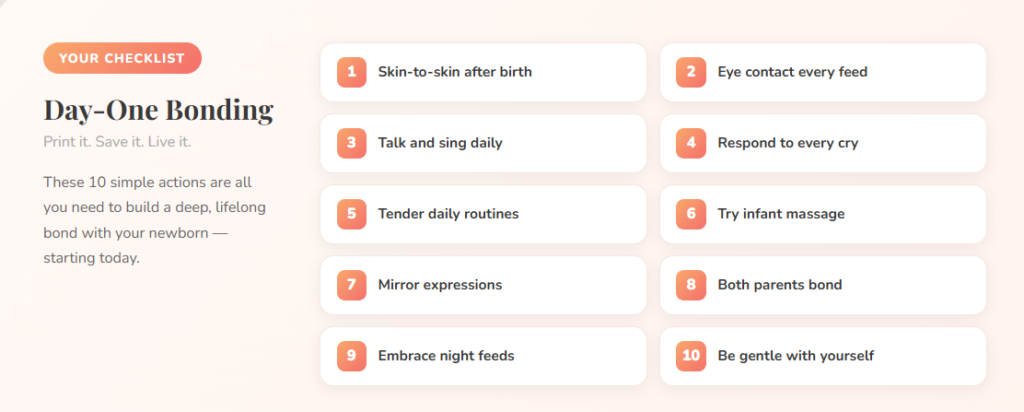
Every time you look into your newborn’s eyes, every time you respond to their cry, every time you whisper their name — you are telling them something they will carry inside them for life:
“You are loved. You are safe. You matter.”
And that is where everything good in parenting begins.